Syntax (autogenerated)
| \typebuffer[...,...][...=...,...] | |
| [...,...] | buffer |
| ...=...,... | inherits from \setuptyping |
| \setuptyping[...,...][...=...,...] | |
| [...,...] | name |
| oddmargin | dimension |
| evenmargin | dimension |
| margin | yes no standard dimension |
| option | mp lua xml parsed-xml nested tex context none name |
| style | style command |
| color | color |
| align | see \setupalign |
| lines | yes no normal hyphenated |
| space | on off normal fixed stretch |
| keeptogether | yes no |
| before | command |
| after | command |
| strip | yes no number |
| range | number name |
| tab | yes no number |
| escape | yes no text processor->text |
| indentnext | yes no auto |
| continue | yes no |
| start | number |
| stop | number |
| step | number |
| numbering | file line no |
| blank | see \blank |
Description
With \typebuffer[mybuffer] you get the verbatim content of buffer mybuffer, which was previously defined with \startbuffer.
To typeset the contents of the buffer, use \getbuffer.
Example
-
\starttext

\startbuffer[mybuffer]
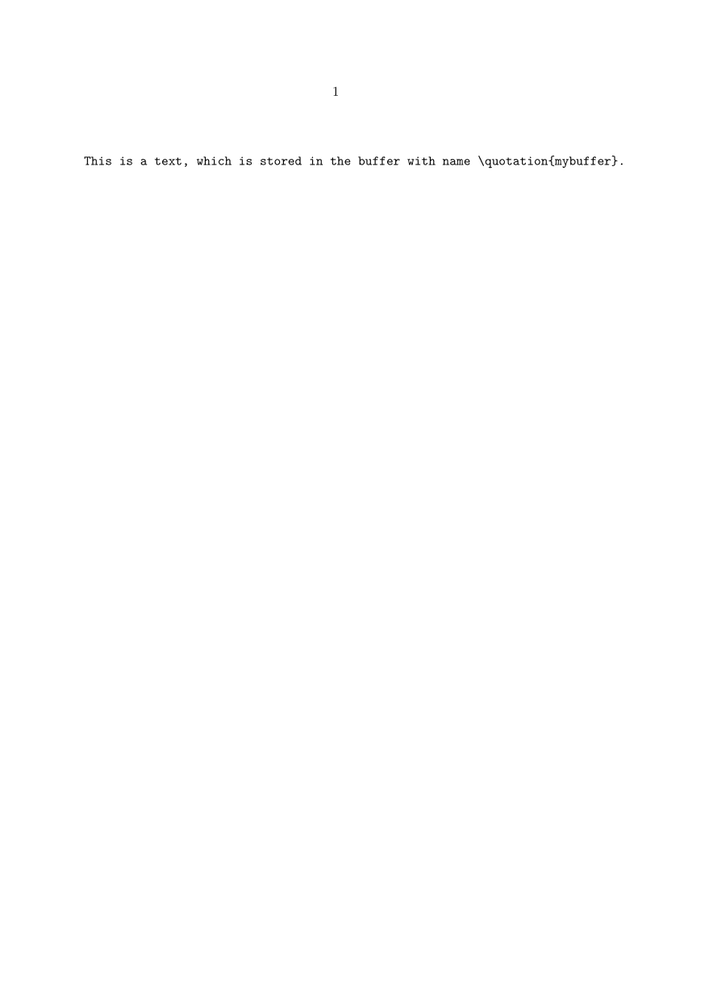
This is a text, which is stored in the buffer with name \quotation{mybuffer}.
\stopbuffer

\typebuffer[mybuffer]

\stoptext
produces
-
You can show only a part of a source:
\startbuffer[BB]
\setupsomething[]
\starttext
% begin
Do something interesting.
%end
\stoptext
\stopbuffer

\typebuffer[BB][option=tex,range={begin,end}]
See also
- \setuptyping – setup also for \type
- \getbuffer - Get back the "formatted" content of a buffer.
- \input - Include the complete content of a text file.
- \startbuffer - Define the content of a temporary buffer.
Help from ConTeXt-Mailinglist/Forum
All issues with: