Contents
Summary
The command \setuplayout is used to define the properties of (the/a) page layout.
Settings
| \setuplayout[...][...=...,...] | |
| [...] | name |
| state | start stop normal repeat |
| margin | dimension |
| edge | dimension |
| margindistance | dimension |
| edgedistance | dimension |
| leftedgedistance | dimension |
| rightedgedistance | dimension |
| leftmargindistance | dimension |
| rightmargindistance | dimension |
| topdistance | dimension |
| headerdistance | dimension |
| footerdistance | dimension |
| bottomdistance | dimension |
| preset | name |
| leftmargin | dimension |
| rightmargin | dimension |
| leftedge | dimension |
| rightedge | dimension |
| header | dimension |
| footer | dimension |
| top | dimension |
| bottom | dimension |
| backspace | dimension |
| topspace | dimension |
| setups | name |
| cutspace | dimension |
| width | dimension middle fit |
| bottomspace | dimension |
| lines | number |
| height | dimension middle fit |
| horoffset | dimension |
| veroffset | dimension |
| columns | number |
| columndistance | dimension |
| method | default normal name |
| location | left middle right top bottom singlesided doublesided |
| textwidth | dimension |
| textheight | dimension |
| nx | number |
| ny | number |
| dx | dimension |
| dy | dimension |
| scale | number |
| sx | number |
| sy | number |
| marking | on off page empty color one two four |
| grid | yes no off |
| textdistance | dimension |
| alternative | default normal makeup name |
| clipoffset | dimension |
| cropoffset | dimension auto |
| trimoffset | dimension |
| bleedoffset | dimension |
| artoffset | dimension |
| direction | normal reverse |
| Option | Explanation | ||||||||
|---|---|---|---|---|---|---|---|---|---|
| Name of the layout – omit for the default (or single) layout. | |||||||||
| margin |
|
||||||||
| edge |
|
||||||||
| margindistance |
|
||||||||
| edgedistance |
|
||||||||
| topdistance |
|
||||||||
| headerdistance |
|
||||||||
| footerdistance |
|
||||||||
| bottomdistance |
|
||||||||
| leftmargin |
|
||||||||
| rightmargin |
|
||||||||
| leftedge |
|
||||||||
| rightedge |
|
||||||||
| header |
|
||||||||
| footer |
|
||||||||
| top |
|
||||||||
| bottom |
|
||||||||
| backspace |
|
||||||||
| topspace |
|
||||||||
| cutspace |
|
||||||||
| width |
|
||||||||
| lines |
|
||||||||
| height |
|
||||||||
| horoffset |
|
||||||||
| veroffset |
|
||||||||
| columns |
|
||||||||
| columndistance |
|
||||||||
| location |
|
||||||||
| marking |
|
||||||||
| grid |
|
||||||||
| cropoffset |
|
||||||||
| trimoffset |
|
||||||||
| bleedoffset |
|
||||||||
| artoffset |
|
||||||||
Settings name
| \setuplayout[...] | |
| [...] | reset name |
| Option | Explanation |
|---|---|
| Activate a named layout or reset the default layout. | |
Description
If the document is singlesided, then the 'outside' is the right side and the 'inside' is the left side.
A picture of a page with each of these layout parameters indicated is shown in Typesetting areas.
You can use the \showframe macro to see the results of your layout. Just put the command before \starttext and lines will be drawn on your document showing the different areas. \showlayout will insert 4 pages with setting values.
Methods
1. Define backspace and width, topspace and height, others only if you need them.
2. Define the margins and set width and height to fit.
Grid Setups
In MkIV, at least, a number of presets for the grid parameter were defined using \definegridsnapping; they can be invoked by e.g. \setuplayout[grid=normal]. The presets are all combinations of the following options:
none |
don't enlarge |
halfline |
enlarge by halfline/halfline |
line |
enlarge by line/line |
strut |
enlarge by ht/dp (default) |
first |
align to top line |
last |
align to bottom line |
mindepth |
round depth down |
maxdepth |
round depth up |
minheight |
round height down |
maxheight |
round height up |
local |
use local interline space |
shift:-3tp |
vertical shift within box |
These are the presets and their definitions.
| \definegridsnapping[normal] | [maxheight,maxdepth,strut] |
| \definegridsnapping[standard] | [maxheight,maxdepth,strut] |
| \definegridsnapping[yes] | [maxheight,maxdepth,strut] |
| \definegridsnapping[strict] | [\v!maxdepth:0.8,maxheight:0.8,strut] |
| \definegridsnapping[tolerant] | [\v!maxdepth:1.2,maxheight:1.2,strut] |
| \definegridsnapping[top] | [minheight,maxdepth,strut] |
| \definegridsnapping[bottom] | [maxheight,mindepth,strut] |
| \definegridsnapping[both] | [minheight,mindepth,strut] |
| \definegridsnapping[broad] | [maxheight,maxdepth,strut,0.8] |
| \definegridsnapping[fit] | [maxheight,maxdepth,strut,1.2] |
| \definegridsnapping[first] | [first] |
| \definegridsnapping[last] | [last] |
| \definegridsnapping[high] | [minheight,maxdepth,none] |
| \definegridsnapping[low] | [maxheight,mindepth,none] |
| \definegridsnapping[line] | [line] |
| \definegridsnapping[strut] | [strut] |
| \definegridsnapping[max] | [maxdepth,maxheight,strut] |
| \definegridsnapping[min] | [mindepth,minheight,strut] |
Pseudo columns
With the columns and columndistance parameters you can set up a design grid that is usually not visible and not related to real columns, but you can use it for placements on Layers. See the Details manual.
Examples
Example 1
-
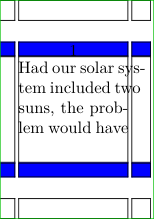
\setuppapersize[A10]

%% This is an example for showing the effect of the vertical parameters
%% top, topdistance, bottom, bottomdistance and topspace.
%% Just play around with these parameters.

\showframe

%% Show the top and the bottom with blue color:
\setupbackgrounds[header, footer][background=color, backgroundcolor=blue]

\def\MyLength{10pt}

\setuplayout[
  top=\MyLength,
  topdistance=\MyLength,
  bottom=\MyLength,
  bottomdistance=\MyLength,
  topspace=\dimexpr(\topheight + \topdistance),
  height=fit]

\starttext
    \input thuan
\stoptext
-
Notes
See also
- \definelayout
- page-lay.mkiv
- Document layout and layers
- Typesetting areas for a visual image of the typesetting areas
- Grid typesetting
- Paper setup section for the predefined paper sizes and Paper sizes for their actuals dimensions in mm.
- \adaptlayout to locally adapt the page layout
- \setuppapersize to set the paper size
- \showframe to make some or all of the page frames visible
- \showlayout inserts 4 pages with layout variable values