Introduction
Setups are a rather common variant on macros. They have two useful properties:
- Spaces inside setups are ignored. This means that you can format the setup’s contents with spaces and linebreaks for maximum readability, instead of having to write a dense macro or, worse, a long in-place definition. You can explicitly request spaces with \space , \crlf , \par , etc.
- If you call the setup inside a \start (just 'start') environment, any definitions made by that setup remain inside that group. This lets you define macros in a setup, and then call the setup inside a group to use the macros as 'local macros' of sorts.
Commands
- \startsetups mysetup begins a setup definition (with optional brackets around mysetup )
- \setup [mysetup] or \setups [mysetup] invokes a setup or even several as a list.
- There’s also \directsetup {mysetup } and \fastsetup {mysetup }, these were faster in MkIV but make no sense any more in LMTX. Both take just one setup name and do less error checking.
Examples
Here are two simple examples:
% Create two setups \startsetups doc:print \setuppapersize[A4][A4] \stopsetups \startsetups doc:screen \setuppapersize[S6][S4] \stopsetups % Use one or another setup \doifmodeelse {paper} { \setup[doc:print] } { \setup[doc:screen] } |
% Set up a headertext. Whitespace is ignored \startsetups[doc:header] \marking[chapter] \space -- \space \pagenumber \stopsetups % Use the setup \setupheadertexts[\setup{doc:header}] |
You can place setups almost everywhere and environment will not be affected by their execution. It is useful to wrap overlay definitions and such in setups as in (copied from Colorful CD inlay page):
\defineoverlay [origin] [\setups{origin}]

\startsetups origin
    \vbox to \overlayheight {
        \vfill\tfxx\setstrut
        \hsize\overlaywidth
        \hfill Fiona Apple\enspace EM\enspace2005\quad\strut\endgraf
        \kern1ex
    }
\stopsetups
You can even do things like:
\starttext
\startsetups settest
    \def\command{do something with}

    I want to \command{} my command.
\stopsetups

\start
    \setups{settest}
\stop

\command aaa  % will give "undefined control sequence" error

\stoptext
See also an example in the tutorial for headers and footers.
\startlines
in setups
Since setups ignore whitespace, \startlines … \stoplines doesn’t work within a setup.
You can use a buffer and call it within the setup. The following example uses the document:stop setup that is automatically placed if you use \startdocument … \stopdocument.
\startbuffer[imprint]
© \currentdate[year] Publisher
…
Printshop etc.
\stopbuffer

\startsetup document:stop
\dontleavehmode\vfill
\subject{Imprint}
\startlines
\getbuffer[imprint]
\stoplines
\stopsetup
Another option is to change the catcode regime and use \startrawsetups:
\pushcatcodetable
\obeylines
\startrawsetups[document:stop]
  \startlines
  © \currentdate[year] Publisher
  foo bar baz
  blah blah
  \stoplines
\stoprawsetups
\popcatcodetable
Using setups for namespaces
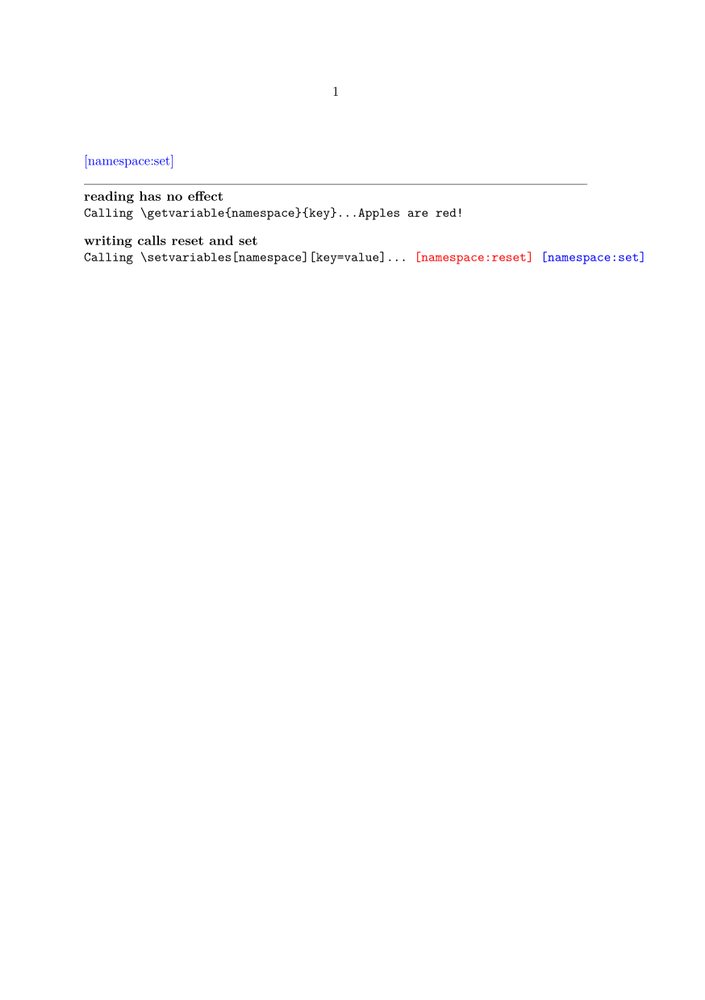
Using \setups for a variable namespace allows an easier control over the containing variables. All you have to do is to define the setups namespace:set and/or namespace:reset for a given namespace. Now every time a variable of that namespace is assigned (written), ConTeXt automatically calls these setups. Reading of variables is totally unaffected by these settings. A possible use are default values, calculations and even verification.
So once you have 'setup' your variables proper, you don't have to worry about unset variables and alike any more. Also changes can be made easy, as there is only one common setup. The drawback is the slower speed in use, as every assignment to a variable calls these setups.
To give you the idea, try this example.
-
When you initialize the namespace, the setups assigned to
setare called.
-
When you assign a variable to the namespace, first the setup in
resetis called, and then the setup inset.
-
\startsetups namespace:set
    % Print message to log and to document
    \writestatus{VARIABLES}{namespace:set is being called..}%
    \space{\blue[namespace:set]}
    \def\applecolor{red}
    % whatever must be done with your variables after you assign a value
    % (initialisation with defaults,..)
\stopsetups

\startsetups namespace:reset
  % Print message to log and document
  \writestatus{VARIABLES}{namespace:reset is being called..}%
  \space{\red[namespace:reset]}

  % whatever must be done after an assignment (verification, calculation,..)
\stopsetups


% \setups[namespace:set] is automatically called right after 'set' is assigned
\setvariables[namespace]
  [set={\setups[namespace:set]},
   key={Apples are \applecolor!},
   reset={\setups[namespace:reset]},
  ]

% watch for the colors
\setupcolors[state=start]

\starttext
\hairline
{\bf reading has no effect\par}
{\tt Calling \type{\getvariable{namespace}{key}}...\getvariable{namespace}{key}}

\blank
{\bf writing calls reset and set\par}
{\tt Calling \type{\setvariables[namespace][key=value]}...\setvariables[namespace][key=value]}

\stoptext
-