Syntax (autogenerated)
| \doloop{...} | |
| {...} | command |
Syntax
| \doloop{commands} | |
| {commands} | Commands or text to repeat |
Description
Repeat indefinitely; stop after a loop in which \exitloop is encountered, or immediately when \exitloopnow is encountered.
Example
-
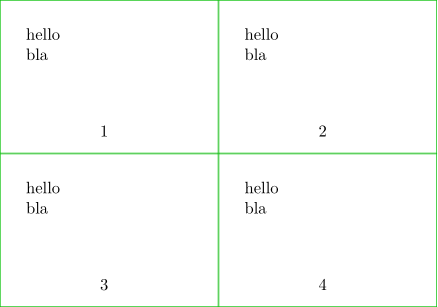
\setuppapersize[A10, landscape][A8, landscape]
\setuppaper[nx=2, ny=2]
\setuppagenumbering[location=footer]
\setuparranging[XY]
\showframe[edge]

\starttext
\dorecurse{4}{
    hello\crlf
    \doloop{
        \ifnum \pagenumber=\recurselevel
            \exitloop
        \fi
        bla
    }
    \page[yes]
}
\stoptext
-
See also
- Loops and Recursion
-
Looping a fixed number of times
- \dorecurse for iterating from 1 to n.
- \dostepwiserecurse for iteration with arbitrary start, end, and step.
- \recurselevel for the iteration number.
- \recursedepth for the iteration depth, in the case of nested \dorecurse and co.
-
'While' loops with exit conditions
- \doloop for a loop that repeats until exited.
- \exitloop to exit a loop.
- \exitloopnow to immediately exit a loop.
- \recurselevel to know which iteration the loop is in.
- \recursedepth to know how many nested loops deep we are.
- \input is also often used to produce dummy text.
- LuaTeX for heavier-duty looping and iterating.
Help from ConTeXt-Mailinglist/Forum
All issues with: