Syntax (autogenerated)
| \definestartstop[...][...][...=...,...] | |
| [...] | name |
| [...] | name |
| ...=...,... | inherits from \setupstartstop |
| \setupstartstop[...,...][...=...,...] | |
| [...,...] | name |
| before | command |
| after | command |
| inbetween | command |
| setups | name |
| left | command |
| right | command |
| style | style command |
| color | color |
Description
Used to define block level commands.
Example
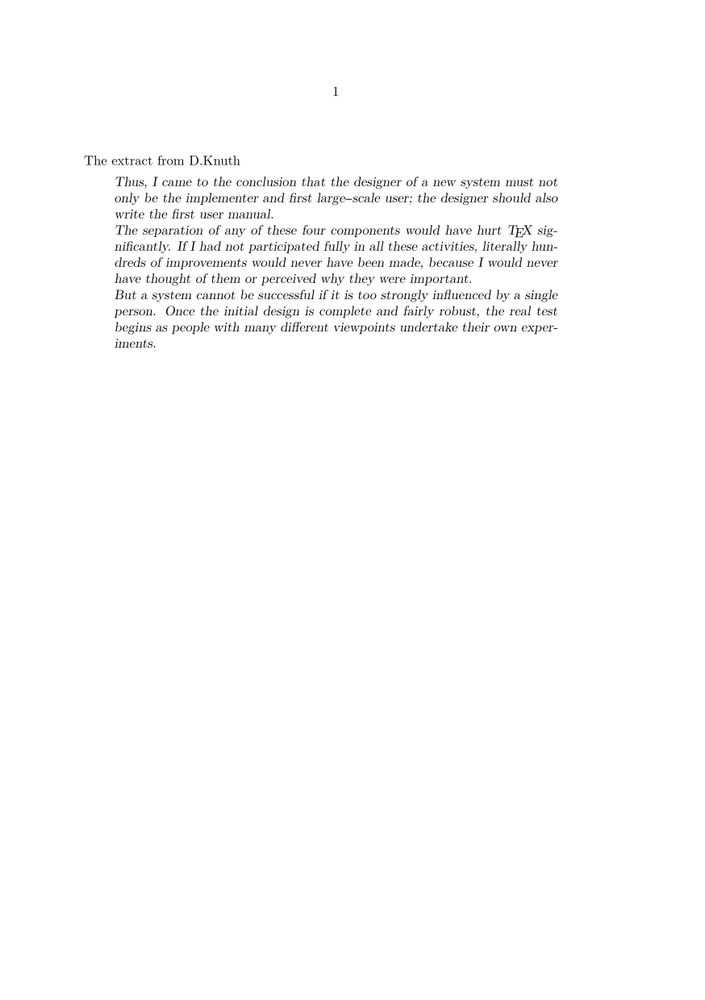
Example: Long Quotations
-
\setuppapersize[A5]

\defineblank[ExtractDistance][3pt]
\definestartstop[Extract][
   style=slanted,
   before={\blank[ExtractDistance]
      \setupnarrower[left=1.5pc,right=1.5pc]
      \startnarrower[left,right]
      \noindent},
   after={\stopnarrower
      \blank[ExtractDistance]
      \indenting[next]}]
%Now the following commands are available: \startExtract and \stopExtract

\starttext
The extract from D.Knuth
\startExtract \input knuth \stopExtract
\stoptext
-
Example: Visualization of left/right, before/after (Source)
-
\usemodule[visual]

\definestartstop
   [Example]
   [before={\par\leftaligned{\tttf [before]}\par},
     after={\par\leftaligned{\tttf [after]}\par},
         left={{\tttf [left]}},
        right={{\tttf [right]}}]

\starttext

\fakewords{10}{20}
\startExample
\fakewords{10}{20}
\stopExample
\fakewords{10}{20}

\blank

\fakewords{3}{5}
\Example{\fakewords{3}{5}}
\fakewords{3}{5}

\stoptext
-

See also
Help from ConTeXt-Mailinglist/Forum
All issues with: